Table of Contents
Indoor saffron farming has exploded across social media over the past few years. You’ve probably seen videos promising huge earnings from a tiny room, stories of people harvesting “red gold” with almost no effort, and claims that a few trays of corms can turn into a high–profit business overnight. The hype is loud. The reality is quieter, more technical, and far less glamorous.
Saffron can be profitable, but only when you understand the actual numbers, the hidden costs, and the biological limits of the plant. This article breaks down the real economics behind indoor saffron production using clear calculations, realistic yield expectations, and current market behavior. No inflated claims. No motivational exaggeration. Just the truth about what works, what fails, and what you need to evaluate before investing your time or money.
If you want a transparent look at whether indoor saffron farming is a smart agricultural venture or just another online fad, this guide will give you the full picture.
Why Saffron Farming Seems Magical: The Hype vs. Reality
Saffron is the dried stigmas of Crocus sativus. A tiny mass of dried threads sells for hundreds of rupees per gram at retail. That headline price is what fuels ads and Instagram posts showing a small room turning into a fortune. Premium Kashmiri saffron commonly sells in the ~₹300–₹600 per gram retail band depending on grade and packing; wholesale is lower. (multiple market pages). [2]
Counterfeit saffron further complicates the market. Studies show up to 50% of saffron sold globally contains fillers like safflower or marigold. Authentic producers must invest in testing and certification to prove purity, adding to costs. When consumers ask what makes saffron expensive, they’re often unaware they’re paying for verification of authenticity as much as the spice itself.

The catch: each gram requires many flowers and manual harvest. The economics are therefore driven by four things:
- Biological yield (how many grams you actually get per area per year).
- Price realised (retail vs wholesale).
- Capital costs (racks, LED lights, HVAC, sensors — if you build a fully controlled room).
- Operating costs (electricity, labour, packaging, Marketing, drying, corm replacement).
If any one of these is unrealistic in promotional material, the whole business case breaks.
The Real Biology Behind Saffron Farming: What Advertisers Don’t Show
- Flower to dried weight conversion: roughly 150 flowers → 1 gram dried saffron (estimate; drying reduces weight significantly and stigmas are tiny). [1]
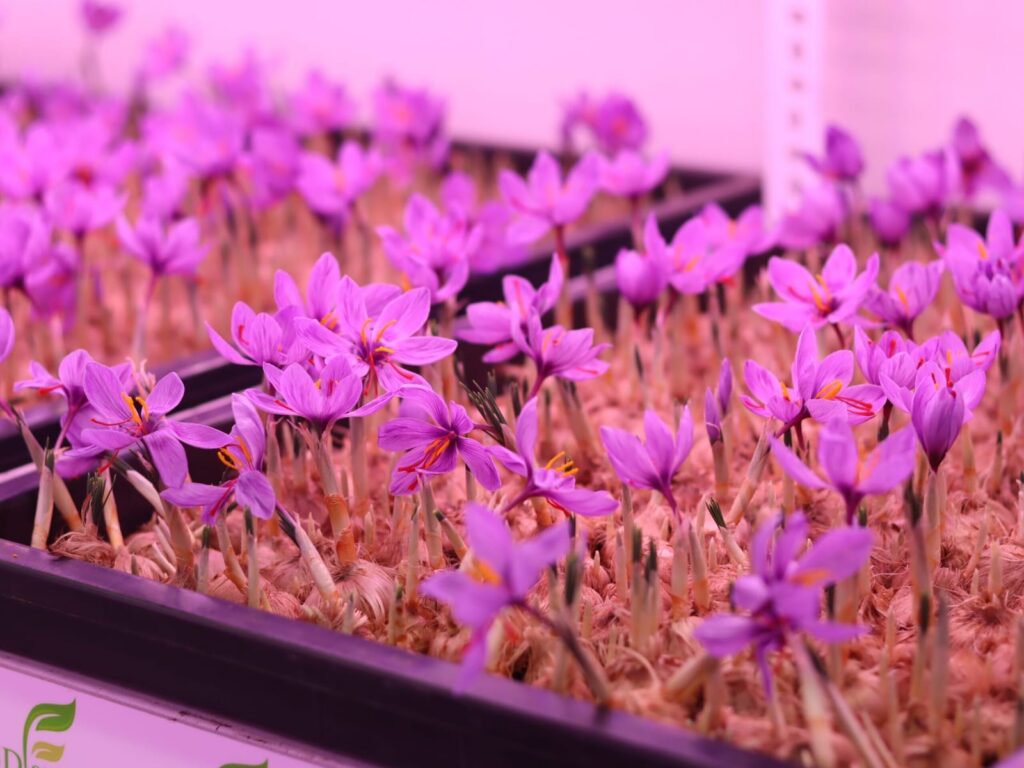
- Labour intensity: each flower must be hand-picked and the three stigmas detached by hand. Skilled labour and timing matter — harvesting is seasonal and time-sensitive.
- Corms & replanting: saffron grows from corms that must be managed; corm replacement or multiplication is a recurring cost.

Saffron Yield Statistics
| Measurement | Flowers Required | Harvest Time |
|---|---|---|
| 1 gram of saffron | 150-200 flowers | 15-20 minutes |
| 1 ounce (28g) | 4,200-5,600 flowers | 7-9 hours |
| 1 pound (454g) | 75,000-100,000 flowers | 300-400 hours |
Bottom line: yields are small per plant and labour is the dominant recurring cost. Any profitability model that ignores labour or uses retail-per-gram assumptions for bulk sales is suspect.
How to Calculate Indoor Saffron Farming Profit
I use three yield scenarios (Low yield, Realistic yield, Optimistic yield) and two CAPEX/O&M models (High, Low) to show a wide but realistic range. I keep all math explicit so readers can follow the arithmetic.
Yield (dried saffron per m² per year)
- Low = 1 g / m² / year
- Realistic = 2 g / m² / year
- Optimistic (well-optimised CEA) = 4 g / m² / year
Price per gram (₹) — sensitivity will be shown later: base used = ₹300 / g (conservative retail-premium). We’ll also show results for ₹200–₹600/g.
CAPEX & O&M models
- High-CAPEX / High-O&M: urban CEA lab setup: CAPEX = ₹26,911 / m², O&M = ₹3,500 / m² / year.
- Low-CAPEX / Low-O&M: adapted, low-tech system in a cool region: CAPEX = ₹5,000 / m², O&M = ₹500 / m² / year.
Sample area sizes shown: 10 m², 50 m², 100 m², 500 m². All calculations below are digit-by-digit so you can audit them.
Saffron Farming Profit Calculations
Per m² arithmetic (base price ₹300/g)
Formula used
- Annual revenue per m² = (yield_g_per_m2) × (price_per_g)
- Annual net per m² = Annual revenue per m² − O&M per m²
- Payback years = CAPEX per m² ÷ Annual net per m² (only if Annual net > 0)
Case: High-CAPEX / High-O&M
CAPEX = ₹26,911 / m²; O&M = ₹3,500 / m²/yr; price = ₹300/g
- Low yield (1 g): revenue = 1 × 300 = ₹300; net = 300 − 3,500 = −₹3,200 per m² per year.
- Realistic yield (2 g): revenue = 2 × 300 = ₹600; net = 600 − 3,500 = −₹2,900 per m² per year.
- Optimistic yield (4 g): revenue = 4 × 300 = ₹1,200; net = 1,200 − 3,500 = −₹2,300 per m² per year.
Conclusion: With high CAPEX and high operating costs, you lose money per m² each year at ₹300/g across the yield band.
Case: Low-CAPEX / Low-O&M
CAPEX = ₹5,000 / m²; O&M = ₹500 / m²/yr; price = ₹300/g
- Low yield (1 g): revenue = 1 × 300 = ₹300; net = 300 − 500 = −₹200 per m² per year.
- Realistic yield (2 g): revenue = 2 × 300 = ₹600; net = 600 − 500 = ₹100 per m² per year.
- Optimistic yield (4 g): revenue = 4 × 300 = ₹1,200; net = 1,200 − 500 = ₹700 per m² per year.
Conclusion: low-tech, low-O&M setups can deliver small positive net per m² — but CAPEX payback still depends heavily on scale and price.
Saffron Farming Profit Example: 100 m² (explicit numbers)
Why 100 m²? It’s small enough for many commercial pilots yet large enough to see meaningful cashflow.
Low-CAPEX/Low-O&M numbers
- CAPEX total = 100 × 5,000 = ₹500,000.
- O&M total per year = 100 × 500 = ₹50,000 / year.
Realistic yield (2 g/m²)
- Annual grams = 100 × 2 = 200 g.
- Revenue = 200 × 300 = ₹60,000.
- Net = Revenue − O&M = 60,000 − 50,000 = ₹10,000 / year.
- Payback = CAPEX ÷ Net = 500,000 ÷ 10,000 = 50 years.
Optimistic yield (4 g/m²)
- Annual grams = 100 × 4 = 400 g.
- Revenue = 400 × 300 = ₹120,000.
- Net = 120,000 − 50,000 = ₹70,000 / year.
- Payback = 500,000 ÷ 70,000 ≈ 7.14 years.
Interpretation: with realistic yields, a 100 m² low-tech project returns ₹10k/yr on a ₹500k investment — payback is extremely long. With optimistic yields, payback becomes reasonable.
When Saffron Farming Becomes Profitable: Break-Even Analysis
You can change three levers: price, yield, CAPEX/O&M. Here are two practical targets and the arithmetic behind them.
Target A — 10-year payback on CAPEX ₹500k
- Required annual net = CAPEX ÷ 10 = 500,000 ÷ 10 = ₹50,000 / year.
- O&M = 50,000 / year (as above) — so revenue must be O&M + Required net = 50,000 + 50,000 = ₹100,000 / year.
- With yield 200 g / year (2 g/m² for 100 m²), required price per gram = 100,000 ÷ 200 = ₹500 / g.
Interpretation: with realistic yields, you need premium pricing (~₹500/g) to hit 10 years. If you can only get ₹300/g, you need higher yields or much lower CAPEX.
Target B — 10-year payback for 100 m² at price ₹300/g
- Required annual net = 50,000 / year.
- O&M = 50,000 / year. So revenue must be 100,000 / year.
- At ₹300/g, grams required = 100,000 ÷ 300 = 333.33 g / year.
- Yield per m² required = 333.33 ÷ 100 = 3.33 g / m² / year.
Interpretation: at ₹300/g you’d need ~3.33 g/m²/yr — above the realistic 2 g estimate and close to optimistic 4 g/ m². Achievable in top CEA setups, but not guaranteed year-to-year for novices.
Indoor Saffron Farming Profit Calculator Worksheet
Indoor Saffron Farming Profit Calculator
Indoor saffron farming PDF
Wholesale vs retail Saffron Pricing (the often-hidden gap)
Many trial economics use retail price per gram (direct-to-consumer), which is the highest price point. Commercial operators selling in bulk will see wholesale prices which can be substantially lower. The difference between wholesale and retail sales channels can change payback by years.
If you plan to sell bulk to a processor or distributor, use a conservative price (₹150–₹300/g) in your model. If you aim for direct retail (specialty jars, traceability, marketing) you can command higher prices but incur packaging, branding and distribution costs.
The Hidden Problems in Indoor Saffron Farming No One Talks About
- Labour timing: harvesting is seasonal and intense; you need enough hands at the right moment. Labour shortages or poor timing reduce yield and quality.
- Corm management: corms fatigue and need replacement/multiplication, which costs both time and money.
- Drying losses: poorly dried stigmas lose weight & value quickly; good drying setup is required.
- Market access: retail-grade pricing needs branding, certification, and repeat buyers; otherwise you’ll be forced to sell wholesale.
Where indoor saffron farming does make sense
- Cool ambient climates where HVAC costs are minimal (you effectively need low energy O&M).
- Growers who already have cheap energy or waste heat (industrial sites, co-located farms with cheap power).
- Operators with direct-to-consumer channels (you can charge ₹400–₹600/g).
- Research/seed multiplication projects where value is not just dried threads but improved corm stock or IP.
If none of these apply, you should be extremely cautious about heavy CAPEX.
Final Thoughts
Indoor saffron farming sits in an unusual space. It’s not the get-rich-quick idea that social media pushes, but it’s also not a bad business when it’s approached with discipline, correct math, and realistic expectations. The crop offers incredible value per gram, but the margins only make sense when a grower understands the limits of the plant and the true cost of controlled environment farming.
If you’re considering this venture, don’t start with motivation. Start with numbers. Run your own calculations. Understand your local market. And build a system that’s reliable before you scale it.
When you do that, saffron stops being hype and starts becoming a measurable, predictable business opportunity.