Table of Contents
In an age where consumers are demanding to know the origin of their food and farmers are seeking better ways to streamline operations, one technology is emerging as a game-changer: blockchain. While it may be best known for powering cryptocurrencies like Bitcoin, blockchain has far-reaching implications for industries beyond finance. Among the most promising of these is agriculture.
This article explores how blockchain in agriculture is revolutionizing transparency within the food supply chain, from farm to fork. Let’s dive into how it works, why it matters, and what it means for the future of farming and food security..
🌾 What is Blockchain Agriculture?
Agricultural Blockchain Technology refers to the use of blockchain—a decentralised, secure, and transparent digital ledger—in various aspects of the agricultural industry to enhance efficiency, trust, and traceability throughout the supply chain. Think of blockchain as a digital record book where each transaction or event (like harvesting a crop, shipping it, or testing for quality) is recorded in a secure, unchangeable way. Everyone involved—farmers, transporters, retailers, and even consumers—can access and verify these records in real time.
Key features of blockchain technology include:
- Decentralization: No single entity controls the data.
- Transparency: All stakeholders can view and verify transactions.
- Immutability: Data, once recorded, is permanent and tamper-proof.
- Security: Cryptographic protocols ensure data integrity and user authentication.
Unlike traditional databases that store data in centralized servers, blockchain distributes information across a network. This decentralized nature makes it ideal for building trust in multi-stakeholder ecosystems such as agriculture.
🧬 Why Blockchain in Agriculture Matters
Agriculture is a complex, fragmented industry involving many players: farmers, suppliers, processors, logistics providers, retailers, and ultimately, consumers. The traditional agricultural supply chain faces several persistent challenges:
- Lack of traceability
- Fraud and mislabeling
- Inefficiencies in transactions
- Payment disputes and middlemen
- Delays in product movement
These issues not only reduce profitability for producers but also endanger food safety and erode consumer trust. Blockchain in agriculture addresses these concerns by enabling a secure, transparent system for recording every transaction and event in the supply chain. By placing data into an immutable ledger accessible by all stakeholders, blockchain technology ensures that no single player can manipulate records, thus fostering accountability and trust across the board.
According to the United Nations, counterfeit food costs the global economy nearly $40 billion per year. Research by MarketsandMarkets reveals that with implemented blockchain, agriculture supply chain generated $60.8 million in market value in 2018 and is predicted to generate $429.7 million in value by 2023, growing at a CAGR of 47.8% during the projected period.
🔗 How Blockchain Improves Food Supply Chain Transparency
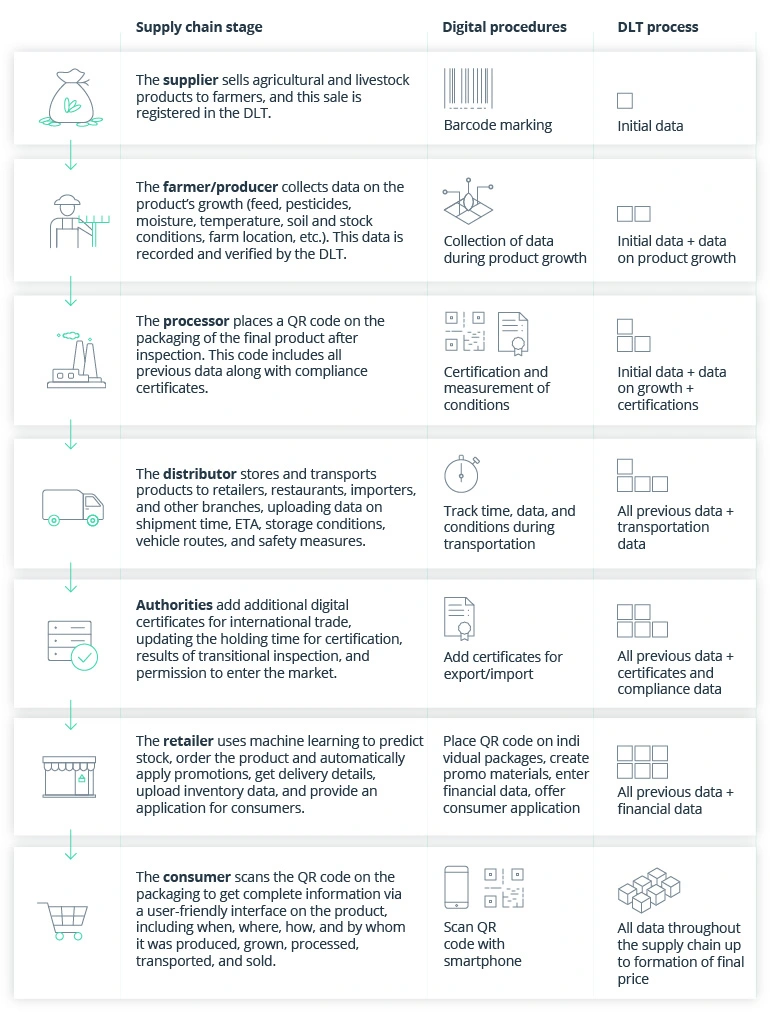
One of the most impactful applications of blockchain in agriculture is improving transparency in the food supply chain. Imagine being able to scan a QR code on a pack of strawberries and instantly learn where they were grown, when they were harvested, who processed them, how they were transported, and when they reached the store shelf.
End-to-End Tracking
Using QR codes, RFID, or IoT tags, each produce batch gets “born” on the ledger. Each stage of the food supply chain—from planting seeds to harvesting, processing, packaging, and transportation—can be recorded on the blockchain. This creates a verifiable, real-time trail that improves visibility for all stakeholders.
Authenticating Food Origins
Blockchain technology allows retailers and consumers to verify the authenticity and origin of food products. This is particularly useful in combating food fraud, such as false labeling of organic or premium products.
Enhancing Food Safety
In the event of a contamination outbreak, blockchain enables rapid tracing of affected products back to their source. This drastically reduces the time needed for recalls and helps prevent widespread illness.
Enforcing Compliance
Governments and certification bodies can use blockchain to monitor compliance with safety and quality standards. Automated alerts and audits become possible, leading to greater regulatory efficiency.
🚜 Key Applications of Blockchain in Agriculture
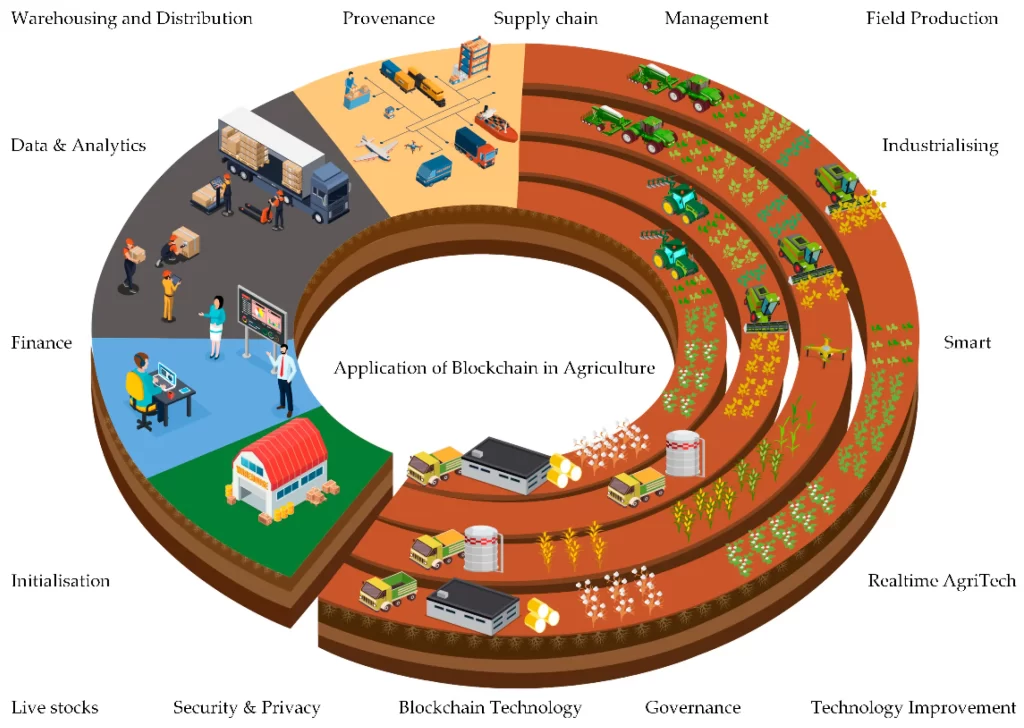
Blockchain isn’t just about transparency—its applications extend across nearly every facet of modern farming and agribusiness. Here are some of the most impactful uses:
Crop and Soil Monitoring
When combined with IoT devices and sensors, blockchain can record soil moisture, pH levels, and crop growth patterns. These immutable records assist in precision farming and sustainable practices.
Livestock Tracking and Management
Blockchain enables complete traceability of animals—from birth, vaccinations, feed history, to processing. This is vital for meat quality assurance and controlling disease outbreaks like foot-and-mouth disease.
Smart Contracts for Transactions
Smart contracts are self-executing agreements encoded on the blockchain. Farmers can use them to automate payments once certain conditions (e.g., delivery or quality benchmarks) are met, reducing dependence on middlemen and disputes.
Supply Chain Financing and Insurance
Blockchain platforms can facilitate microloans and crop insurance by verifying land ownership, yield history, and input purchases. This gives smallholder farmers access to financial tools previously unavailable to them.
🏷️ Traceability and Consumer Trust
Today’s consumers are increasingly aware and demanding transparency. They want to know where their food comes from, how it was grown, and whether it was ethically produced. Blockchain-powered traceability is a direct response to this demand. Brands and producers can integrate blockchain with mobile apps, allowing consumers to scan a product and get a full breakdown of its journey—from farm to fork.
Empowering the Conscious Consumer
Consumers can make informed choices based on verified data. For example, a coffee drinker can choose beans from a cooperative in Colombia that pays fair wages and uses sustainable farming methods.
Building Brand Loyalty
By offering full transparency, food brands can build stronger relationships with customers. Trust becomes a competitive advantage, especially in the organic, health, and gourmet sectors.
Preventing Greenwashing
With blockchain, companies can no longer make unverifiable sustainability claims. Any environmental or ethical claim must be backed by data visible to the public, reducing the risk of “greenwashing.”
💰 Blockchain Farming and Its Impact on Farmers
Blockchain doesn’t only benefit consumers and retailers; it also has immense potential to transform the lives of farmers, particularly in developing countries.
- Direct Market Access: Farmers can bypass intermediaries and sell directly to buyers via blockchain marketplaces. This means better prices, faster payments, and stronger buyer relationships.
- Fair and Transparent Pricing: Smart contracts can ensure that pricing agreements are honored. With payment terms written into the blockchain, farmers receive their dues automatically and without delay.
- Improved Access to Credit: Blockchain records of land ownership, harvest yields, and transaction history serve as a credit profile. This enables farmers to access loans and insurance even without traditional collateral.
- Reducing Exploitation: Because blockchain records cannot be tampered with, it becomes easier to protect farmers from exploitative practices, contract breaches, and unfair trade terms.
🌐 Real-World Applications and Case Studies
Several organizations are already using blockchain in agriculture with measurable success. Here are a few noteworthy examples:
- IBM Food Trust + Walmart: Walmart partnered with IBM to use blockchain for tracing leafy greens. What previously took 7 days to trace now takes just 2.2 seconds. This system is being extended to other perishable goods.
- TE-FOOD in Vietnam: TE-FOOD implemented a blockchain solution for tracking pork in Vietnam. It enables consumers to view the pig’s history, slaughterhouse data, and packaging information.
- AgriDigital in Australia: AgriDigital uses blockchain to streamline grain trading. Farmers receive real-time payments and verified contract data, improving cash flow and trust.
- VeChain + Walmart China: VeChain tracks the origin and safety compliance of pork products sold by Walmart China. Consumers can scan QR codes for instant access to the product’s journey.
- Coffee Farmers in Ethiopia: Blockchain is being used to track Ethiopian coffee from harvest to export. Buyers can verify quality and origin, while farmers gain higher value for their crops.
🧠 Benefits of Using Blockchain in the Agri Supply Chain
The adoption of blockchain in agriculture offers significant benefits for every stakeholder:
- Improved operational efficiency through automated contracts and real-time data
- Enhanced food safety due to transparent supply chain tracking
- Stronger consumer trust through verified traceability
- Reduced fraud and mislabeling
- Faster dispute resolution among supply chain partners
- Better sustainability tracking, including water and carbon usage
These advantages make blockchain not just a technological upgrade, but a paradigm shift for how we grow, trade, and consume food.
⚠️ Challenges and Limitations of Blockchain in Agriculture
Despite its promise, blockchain adoption in agriculture faces notable hurdles:
- High Implementation Costs: Deploying blockchain infrastructure and training personnel can be costly, especially for smallholder farmers.
- Limited Digital Literacy: Many farmers lack the necessary digital skills to interact with blockchain platforms, especially in developing regions.
- Infrastructure Gaps: Reliable internet and mobile connectivity remain a barrier in rural areas. Without basic infrastructure, blockchain solutions are impractical.
- Regulatory Uncertainty: Governments are still exploring how to regulate blockchain, which creates legal ambiguity for stakeholders.
- Integration Complexity: Blockchain works best when integrated with other technologies like IoT, AI, and GPS—requiring complex system design and investment.
Related
- Why Every Modern Farm Needs Renewable Energy (Before It’s Too Late)
- Biotechnology in Farming: GMOs, CRISPR, and Future Crops
- Precision Agriculture Explained: Benefits, Tools, and Applications
🔮 The Future of Blockchain in Agriculture
As technology evolves and adoption increases, the future of blockchain in agriculture looks promising.
- Integration with Emerging Technologies: Blockchain will increasingly be paired with IoT sensors, AI-powered analytics, and satellite monitoring to offer a holistic approach to agricultural management.
- Decentralised Marketplaces: Blockchain-based platforms will allow farmers to trade produce directly with buyers worldwide, creating a global marketplace with minimal barriers.
- Climate-Smart Agriculture: Blockchain can be used to monitor carbon emissions, water usage, and soil health—helping farms meet sustainability goals and access climate finance.
- Broader Inclusivity: Efforts are underway to develop low-cost, mobile-based blockchain tools to make this technology accessible to even the smallest of farmers.
As stakeholders continue to innovate and invest in infrastructure, blockchain will play a pivotal role in shaping the future of agriculture.
Food is personal. It sustains us, connects us, and shapes our culture. Blockchain is no longer just a buzzword — it’s transforming the way we grow, distribute, and consume food. By making the entire food supply chain transparent and tamper-proof, blockchain empowers farmers, suppliers, retailers, and consumers with something we all need: trust. From knowing exactly where your coffee beans were harvested to confirming whether your organic veggies are truly organic, this technology brings accountability to the table — quite literally.
But for blockchain to really make a difference, collaboration is key. Governments, agritech startups, cooperatives, and consumers must come together to build an ecosystem where data isn’t just collected, but shared responsibly and securely. The future of food is smart, sustainable, and transparent — and blockchain is one of the most promising tools to get us there. As the technology matures, the question isn’t whether agriculture will adopt blockchain — it’s how fast and how far.